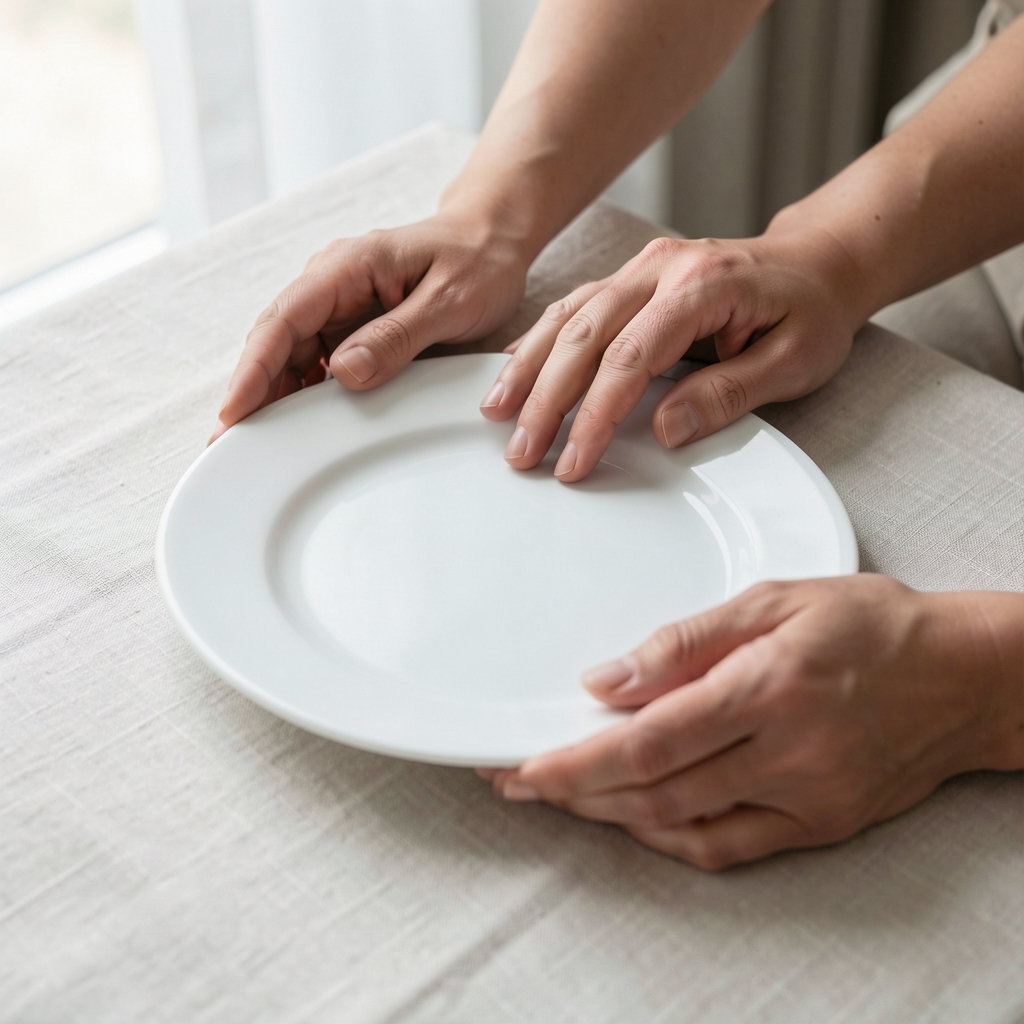
Food journalling is not an act of accounting. It is, when approached without compulsion, a form of slow attention — a means of creating, in retrospect, the observation that the eating itself did not permit. The notebook beside the plate does not change the meal that just happened. But over time, and with a degree of honest observation, it changes what becomes visible about the meals that follow. This piece examines what food journalling makes possible, and what it requires.
Why writing works when memory does not
Memory for eating is notoriously unreliable. Studies of dietary recall consistently find that people underestimate total intake, misremember what they ate, and compress episodes of habitual snacking into a generalised impression that bears little resemblance to the actual sequence of events. This is not deception; it is the ordinary function of memory operating in the context of repeated, low-attention behaviour. Eating without hunger does not tend to be encoded with any particular clarity; it leaves a vague residue rather than a clear recollection.
The notebook creates a different kind of record. Written at or near the time of eating, it captures the specifics that memory will later average away: what was eaten, at what time, in what mood, following what event, in what eating environment. The act of writing is itself a form of attention — it forces a brief pause in which the eating, already done, is observed from the outside. This observation is not the same as mindful eating awareness during the meal, but it is a practical alternative for the many occasions when in-the-moment awareness was absent.
Over a period of days and weeks, this record becomes a resource. Patterns that were invisible in any single meal — the consistent mid-afternoon habitual snacking, the particular eating triggers associated with certain kinds of days, the eating pace that changes between weekday and weekend — become legible in the aggregate. The notebook does not tell anyone what to do; it tells them what has been happening.
The question of what to record
The temptation, when beginning a food journal, is to record everything with precision — exact quantities, caloric estimates, nutritional breakdowns. This approach tends to produce a record that is both demanding to maintain and difficult to read in any meaningful way. The arithmetic takes over. The journal becomes a ledger rather than a log, and the act of keeping it becomes associated with anxiety rather than observation.
A more useful approach is to record the context rather than the content. What was eaten is less informative, in most cases, than when it was eaten, what mood accompanied it, and whether physical hunger was present or absent. A note that reads "biscuits, mid-afternoon, bored, not hungry" is more useful for understanding eating triggers than a note that reads "3 biscuits, 180 kcal." The first note describes a situation; the second describes a transaction.
"The notebook is not for counting. It is for the particular kind of honesty that becomes possible only when the moment has passed and there is nothing left to justify or defend."
Jasper Carrington, JAKOBSEN BU-HU PIERCING
Attention while eating: the journal as proxy
The ideal of attention while eating — of being genuinely present to the pace, texture, flavour, and physical experience of a meal — is harder to realise than it sounds in the context of everyday life. Most meals are eaten in the middle of something else: a conversation, a screen, a task, a thought that arrived and refused to leave. Distracted eating is not a failure of discipline; it is the default condition of eating in the modern day, particularly at times when the eating environment is not specifically designed for attention.
The journal offers a workaround. Where attention during the meal was unavailable, the journal creates a space for attention after it. The few minutes spent writing a food journal entry — what happened, what was felt, what the body registered — serve a function similar to the pause that mindful eating awareness requires. They do not reproduce the real-time experience of attentive eating, but they accumulate a retroactive record that begins to perform a similar function over time.
In particular, the journal helps with recognising fullness cues. Many people find that, in writing about a recent meal, they become aware of signals they registered at the time but did not act on: the point at which eating felt complete, or the moment at which continuation became something other than appetite. This retroactive recognition, repeated over many entries, tends to sharpen the ability to notice the same signals prospectively — to catch them in the moment rather than in the notes.
- Memory for eating is unreliable in predictable ways; writing creates the kind of specific, contextual record that memory tends to average away.
- Mood, timing, and hunger status are more informative to record than quantities or estimates — the context of eating reveals more than its content alone.
- The journal functions as a proxy for attention while eating when real-time awareness was unavailable, and can help develop the skill of recognising fullness cues over time.
- Brevity is more sustainable than completeness — a few words per eating episode, maintained consistently, produces more useful patterns than detailed daily records kept for a week and then abandoned.
Mindful portion awareness and the scale problem
One of the less-discussed aspects of food journalling is its potential to support mindful portion awareness — not through measurement, but through observation. People who write about their eating over a sustained period often report a gradual shift in their sense of what constitutes a satisfying quantity. This shift does not come from counting; it comes from the accumulation of comparative data across a wide range of eating experiences, with the mood and hunger states noted alongside.
What tends to become visible is the relationship between eating pace and fullness across different contexts. A meal eaten quickly, without attention, in front of a screen tends to be described in the journal entry as either insufficient — "wanted more, kept eating" — or as having produced discomfort — "ate too much, didn't notice". The same meal eaten slowly and with some deliberate attention tends to produce a different entry. The journal, read across time, maps this relationship more reliably than any single moment of introspection.
On maintaining the practice without compulsion
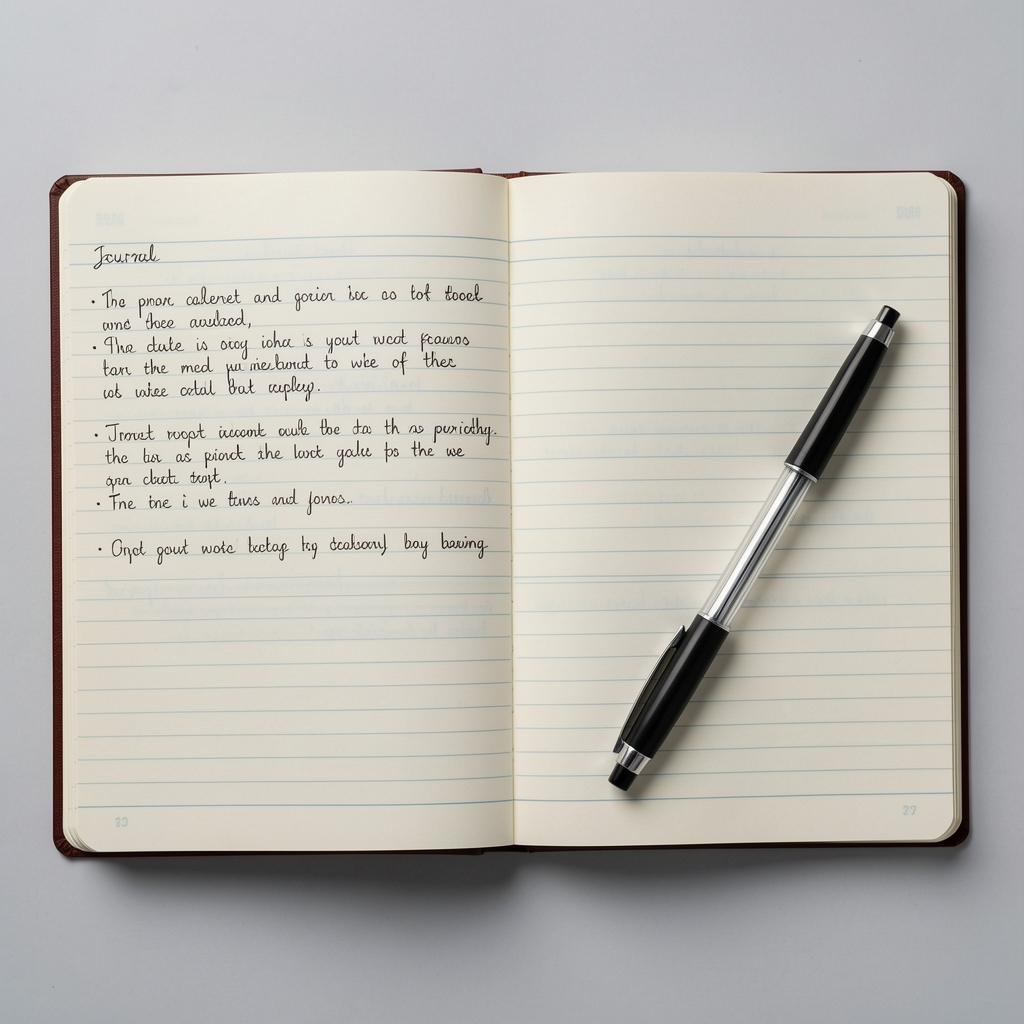
Food journalling tends to falter when it becomes obligatory — when the missed entry becomes a source of guilt, and the guilt makes the next entry feel loaded before it is begun. The most useful frame for the practice is one of occasional, honest observation rather than complete and compulsory record. A notebook in which three days a week are recorded with real attention is more useful, and more sustainable, than one in which seven days are recorded with anxious thoroughness.
This means, practically, that the journal is kept with as little pressure as possible. The objective is not to account for every eating episode but to develop a habit of reflection that becomes, over time, a habit of awareness. The transition from retrospective noticing to prospective noticing — from recording what happened to pausing before it happens — tends to occur gradually and without any particular moment of decision. The notebook does its work quietly.
Slowing down at mealtimes, in this context, is not a technique that the journal teaches so much as a quality that it tends to encourage indirectly. When the eating becomes something that will later be written about — even briefly, even in a sentence — there is a small but real change in the quality of attention brought to it. The meal is, in some diffuse way, already under observation. This is enough, in many cases, to slow the pace slightly, to extend the space in which recognising fullness cues becomes possible.
Articles published on JAKOBSEN BU-HU PIERCING are editorial in nature and reflect the writers' observations on everyday wellness practices. The content is not intended as guidance for the management of any specific condition. Readers with specific concerns about their daily routines are encouraged to speak with a qualified wellness professional.